
This is how to always get good performance reviews.
周日好,我的职场小伙伴。
Early in my career, I had just one goal for performance reviews: survive them.
Before each one, I’d experience this strange mix of fear and hope:
Fear of being judged.
And hope that my hard work would be seen.
Like many Chinese professionals, I believed that my work would speak for itself.
But when I became a manager, I realized something:
The direct reports who I gave the best performance reviews to? They didn’t passively rely on my judgement.
They actively chose and presented the facts that gave me the best understanding of their impact.
Because managing a team of 20 people split my attention in too many directions. I saw only fragments of each person’s work: a presentation here, a result there, some feedback from stakeholders.
Most of what I knew came from what they told me.
Write your performance review the right way
Your goal is simple: Help your manager see your impact clearly.
Not by bragging or exaggerating, but by selecting the right evidence.
And in my career, there’s one tool that has always helped me do this: The Brag Book.
“Brag” might make you cringe. I get it.
Even growing up in Canada, my own parents constantly reminded me to be 谦虚.
But the Western workplace isn’t the Humble Olympics. You don’t get a gold medal for being the humblest employee.
You just get forgotten.
By using a Brag Book, you can keep a personal record of achievements (updated throughout the year, not the night before your review).
Here’s how to build it:
Write one story per project, using STAR (Situation, Task, Action, Result). Keep it factual and objective to maintain trust.
Connect Actions to the company values (to show your alignment) and your personal development goals
Show business impact. Ask yourself: “How does my company make money, and how does my work contribute?”
Include “Receipts”. This is proof of work: Screenshots, reports, code, messages.
💡 If you’d like my personal Brag Book template, message me on WeChat (Jonathan_Coach).
Your Brag Book helps you highlight wins…but don’t forget your growth areas. Managers trust balanced self-awareness.
So how do you self-critique, without self-sabotaging?
Instead of presenting a “problem”, pair it with a solution. Show how you’re planning to improve (or already improving):
“Stakeholder communication is one area I’m developing. I’ve started daily updates in Teams to keep alignment.”
Your review conversation is actually a negotiation
Even with preparation, review meetings can feel intimidating. I know it felt that way for me.
But here’s what nobody told you about these discussions: They’re not judgements. They’re negotiations.
Your goal in every review conversation is to negotiate two things:
Negative feedback
Future expectations
Negotiating Negative Feedback
When negative feedback inevitably comes, it can sting. I definitely did for me.
Your goal here is simple: minimize the negative impacts from the feedback.
But many people try to minimize it in a counterproductive way. I totally understand the urge to react defensively. Heck, I’ve been there myself. But defensiveness only brings you further apart from your manager in negotiations.
Instead, I’ve found that responding to feedback with questions has been a game-changer. Because understanding your manager’s point of view gives you the best chance to influence it.
So take a breath, and ask:
“Could you share a specific example?”
“Is this more about my process or my communication?”
“What would a stronger version look like?”
When they’ve had their say, you’ll get the opportunity to have yours. And the entire vibe of the conversation will be much more open and receptive. This is when you can start negotiating their perception:
“I see what you mean about missing deadlines last quarter. A lot of that came from new project handoffs without clear owners. Would it make sense if I proposed a standard kickoff checklist to prevent that going forward?”
And if after understanding them, you still feel that any feedback is unfair, take time to reset. Just say:
“I’d like to take some time to reflect. Can we schedule a follow-up next week to review next steps?”
Take time to collect evidence and structure your thoughts, and come back for the next round of negotiation.
Negotiating Future Expectations
Most people walk into a review wanting the output: more salary, bigger title. But salary and promotions are not what you negotiate in the review.
You negotiate the input that creates them: expectations.
If you don’t align on expectations, you leave your next review up to luck, memory, and your manager’s personal standard.
So your goal in this part of the conversation is simple:
Turn “I hope they see my value” into “We already agreed on what great looks like.”
To do it, ask future-focused questions like:
“What would ‘exceeding expectations’ look like for me over the next 6–12 months?”
“What’s the next big challenge you’d like to see me take on?”
“Which skills, if I level them up, would make me promotable?”
A great example of the power of negotiating expectations comes from my wife.
When she was trying to get promoted from senior data scientist to the staff level, her manager expected the world from her.
“You need to lead a major cross-org initiative, to show your impact”, he said.
But she had received the top performance review every year. And in the words of her previous manager, “when you’re performing at the highest level, you don’t need to do even more to maintain it. You’re doing enough.”
So she asked for advice from her previous manager. He had a brief chat with her current manager. Guess what? Her current manager came back to her with an apology, and a much more realistic roadmap to get promoted.
And as she always does, she crushed it and got that promotion 6 months later.
If she hadn’t challenged her manager’s expectations, she almost certainly would have been stuck.
Bonus: Discussing promotions/pay raises
I mentioned earlier that you can’t really “negotiate” promotions and pay bumps. But that doesn’t mean you can’t take an active role in shaping the discussion. It’s a topic that many of my candidates struggle with, so here’s a simple template you can use to bring it up to your boss:
“By leading three cross-functional projects, I’ve developed and showcased the skills needed for a formal Senior Analyst role. Could we discuss what steps are needed to make that transition?”
If the answer is “not yet,” don’t stop there. It’s time to pivot the conversation to create a clear path forward. Follow up with:
“I understand. Could we document measurable goals instead, so I know exactly what to achieve before revisiting this next month?”
That’s how you turn “no” into “not now.”
By scheduling regular check-ins with your manager to track your progress against your development goals, you’re taking control of your career.
You transform a single annual review into 12 checkpoints to negotiate your performance, and show your value.
That’s how you can finally stop surviving performance reviews, and start driving them.
If you’re feeling stuck: job seeking, or growing in your career, I’d love to help. Let’s reach your goals together, step by step.
Melon Break 🍉
Chips, Chicken, and Charts: The Wild Logic of the AI Boom
It’s time to 吃瓜.

This week, the internet went wild after Nvidia’s CEO, Jensen Huang, was spotted in Seoul having beer and fried chicken with Samsung and Hyundai’s top bosses.
Can you guess what happened next? Investors lost their minds, of course. Shares of other fried chicken brands and even a robot chicken-fryer company suddenly soared up to 30%, just because of that one dinner photo.
And I have to wonder: if even fried chicken can profit off the AI boom, what does a career coach need to do to get in on this? I guess I’ll have to build an AI version of myself.
(JK*, I’d rather retire and go live in the mountains).
Meanwhile, some say this might be a Pets.com** moment, when a boom turns into a bubble.
Morgan Stanley’s analysts released a recent report that the AI industry has become “increasingly circular”, which is a professional way to say that chipmakers, AI companies, and other big players are all funding each other in a never-ending spiral.
Here’s the chart they made:
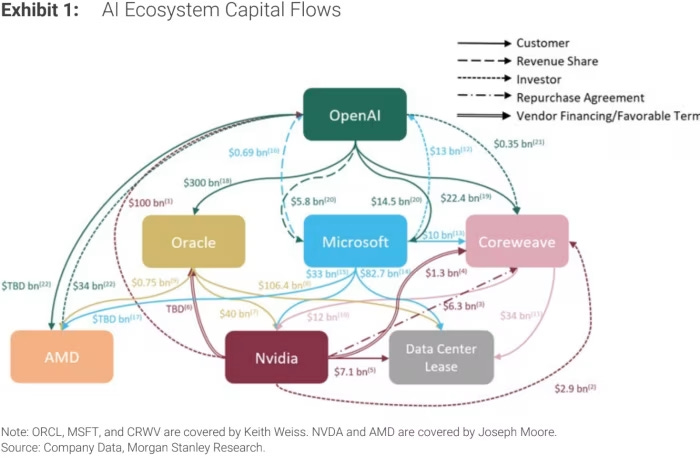
If that confuses you, The Financial Times proposed another visualization (no joke, they actually posted this):

💬 Use it at work
Here’s how you can bring this up naturally during small talk:
With coworkers:
“Did you hear about how Nvidia’s CEO made fried chicken stocks go crazy in Korea? Where is AI mania going to hit next?’”With your boss:
“This reminds me that sometimes, narrative can be more powerful than data. People make decisions based on stories as much as numbers.”
*JK: Millennial slang for “just kidding”
**Pets.com: A famous failed dot-com company that became a symbol of crazy internet-bubble investing
If you enjoyed this read, the best compliment I could receive would be if you shared it.