
The real reason your presentations don’t work (and how to fix it overnight).
周日好,我的职场小伙伴。
During my first internship at P&G, I delivered my first real corporate presentation: a campaign brief for an ad we were going to run during the Olympics. It was going to be a full room of senior brand managers.
I wanted to look smart. I wanted my manager to be impressed. I wanted everyone to see how hard I’d worked.
I walked into the room confident.
I walked out a different person.
Because after two slides, my manager interrupted me with sharp questions. And after the meeting, she pulled me aside and said something I’ll never forget:
“I can tell you put a lot of effort into this. But honestly, that presentation was a waste of time for everyone in the room.”
Harsh? Maybe.
True? Completely.
My deck wasn’t guiding anyone. It wasn’t helping them make a decision. It wasn’t solving a problem.
It was all about me: my work, my effort, my desire to look creative and smart.
I went home stunned. But after days of thinking, the insight finally clicked:
A presentation is not for you.
It’s for the audience.
Your job is to guide them where they need to go.
And when you shift your mindset from performer to guide, your confidence changes instantly.
You don’t need to look smart.
You have nothing to prove.
You just need to focus on helping your audience.
Here’s how to do it.
The GPS Framework
Based on years of presenting to governments, investors, and executives, I developed a simple, universal structure you can use for any presentation in the Western workplace.
I call it GPS, or Guide → Path → Support.
And to show its universal appeal, I’ll walk you through how to use it for three of the most common kinds of presentations:
Leadership: Senior audiences who need to make fast decisions
Large Audiences: All-hands, town halls, rooms full of people who don’t care (yet)
Team: Your immediate team, stakeholders and collaborators who need clear insights
Guide
Every great presentation begins with one simple question:
“What is the ONE thing I need my audience to remember?”
Not everything, not “only” three things. Just one.
Why? Because we’re human. Our brains forget almost everything.
Research shows people lose about 50% of new information within an hour, and up to 90% within a week.
The more you say, the less of it they remember.
When I force myself to simplify, I often panic. “It’s a lot more complicated than this! It’s nuanced!”
But it isn’t. The mark of a truly talented communicator is the ability to make complex topics sound simple. Most people try to do the opposite, and that’s why people tune them out.
So write your one sentence. Don’t move on until you have it.
Guide for Leadership Presentations
Say the decision first. No context, no warm-up.
“We recommend launching in Q2.”
Executives want BLUF (bottom-line-up-front) because it makes it easy for them to decide.
I almost always start with an “Executive Summary” slide for this reason. The goal of this slide is simple: “If an executive has to leave the meeting right after the slide, they will know what needs to be done.”
Guide for Large Audience Presentations
Start with a story that leads to your message.
As humans, we can’t help but pay attention when we detect a story forming. It’s neuroscience.
When my client was preparing a deep-dive into launching bank deposit insurance at her company all-hands, we scrapped her original intro which included technical details of the project.
We replaced it with this:
“When you deposit money at the bank, what do you expect above all? You want your money to be safe, right? Well this safety and trust is what we spent the last 6 months delivering.”
Afterward, she told me that her story differentiated her from all the other presenters, and even got congratulatory messages from complete strangers.
Guide for Team Presentations
State your key insight. The one thing you want them to take away.
“Sales are down 21% year over year, and we need to mobilize our marketing team to run more promotions”
People you work with closely care most about the “so what” for them, and if you don’t give them a reason to care early, they’ll tune out.
Path
Your “Path” is the short journey that takes the audience to your destination.
Research shows that working memory can only hold 3 to 4 “chunks” of information at once.
So, use the “Rule of Three” to increase recall.
Choose three reasons, three insights, three drivers, or three issues.
Path for Leadership Presentations
“There are three reasons we recommend Q2: revenue upside, supply readiness, and competitor timing.”
Path for Large Audience Presentations
Problem→Search→Solution
“We saw X… we explored Y… and achieved Z breakthrough.”
Path for Team Presentations
What we found→What it means→What we’re proposing
“Our analysis shows X; this implies Y; so we’re recommending Z.”
Support
Your “Support” section reinforces your path by providing evidence, proof, and supporting points.
Some rules of thumb for your support slides:
Less is more
A slide that forces people to read and listen at the same time is a broken slide.
Our brains cannot do both.
Guy Kawasaki’s famous 10-20-30 rule (10 slides, 20 minutes, 30-point font minimum) may be over-generalized, but the core truth it emphasizes is simplicity.
1 idea per slide
This helps you stick to the concept of less is more. Don’t force your audience to decide what to pay attention to. A good guide clears the way, and provides a single, simple path.
Bottom line up front
In most cases, your slide title should be your main point. Are there exceptions? Of course.
But I’ve seen far too many slides titled:
“Q4 Performance Analysis”,
when they should have been:
“Margin trends upward in Q4, driven by higher-profit customer segments”
The title is the highest-visibility part of the slide. The first thing your audience sees.
Don’t waste it.
Presentation Design
What about the design of your actual slides? They have to look pretty right?
Not at all.
I can already picture the management consultants and agency account managers gasping in horror.
Look, I’m not suggesting you should go out of your way to make your slides look ugly. There’s a basic level of design that can be achieved right out of the box with templates, which shows the required respect for your audience.
But design is a vanity game, and I will die on this hill if I must.
If you’re a design snob and can’t bear to use standard templates, I’ll suggest a solution that I’ve used: Gamma.app.
It’s an AI deck-building tool, and it works like magic. They don’t pay me to say this, I just like the tool.
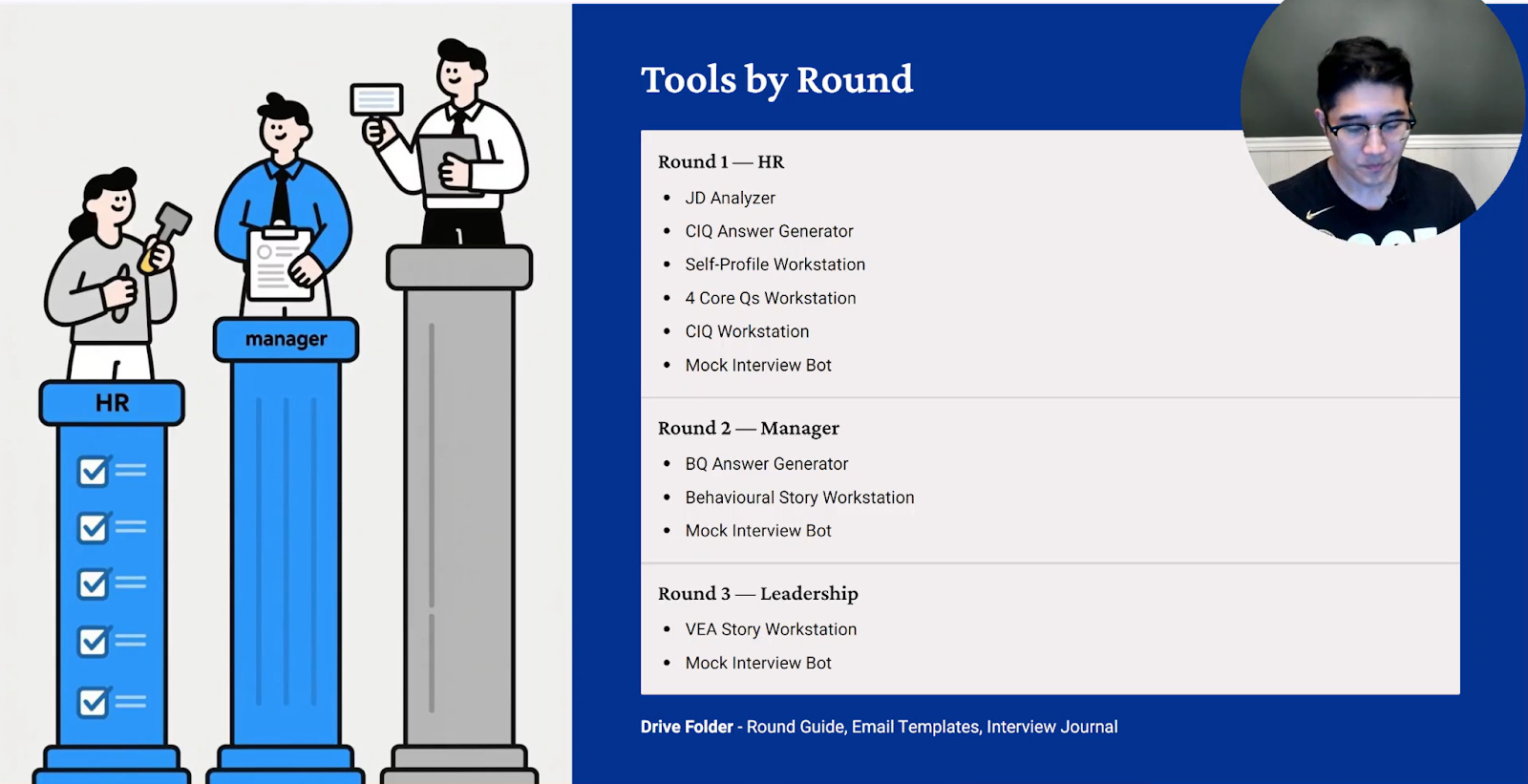
This past July, as I do every single summer, I updated my PainkillerTM Interview Course with the most up-to-date interview market knowledge, tactics, and AI tools.
In total, I spent over 100 hours on this update, and I rolled it out to all of my clients, for free. It’s my way to continue to deliver value as a coach, level up myself, and produce the best product on the market.
I spent 99 hours on the content, the story, and the tools. And just 1 hour on the slide design. As it should be.
Your ideas deserve a stage.
Your voice deserves to be heard.
Your career deserves the opportunities that great presentations can unlock.
So the next time someone asks,
“Can you present this?”
I hope you say yes.
Not because you’re fearless, but because now, you finally feel prepared.
If you’re feeling stuck: job seeking, or growing in your career, I’d love to help. Let’s reach your goals together, step by step.
Melon Break 🍉
A side of politics with your turkey?
It’s time to 吃瓜.

Most years, Americans sit down for Thanksgiving… and then avoid talking about anything real. But this year, a trend is sweeping through the nation. Many families are ditching the “safe topics” and bringing politics straight to the dinner table.
Some say it’s a sign of the dividing times that we are in, where both sides feel the need to “convert” the other. Some say it’s honest and healthy. Others say it ruins the turkey. The big idea is that modern politics are increasingly touching everyday life, and more young people feel it’s better to talk openly, even if it gets a little awkward.
This year, you may not personally be having these conversations. From my observation, we Chinese don’t tend to be so politically eager, especially as diaspora*. But many of your American coworkers grew up with it. And that’s something to remember this season, especially if it comes up at work this Monday.
💬 Use it at work
Here’s how you can bring this up naturally during small talk:
With coworkers:
“I’ve been hearing about a trend of talking politics with family at the Thanksgiving table! Sounds intense!’”With your boss:
“I’ve been reading about how political conversations are becoming more common at American holiday dinners, just like this past Thanksgiving. It seems that a conversation and perspective shift is happening in the newer generations.”
*Diaspora: people who have spread or been dispersed from their homeland
If you enjoyed this read, the best compliment I could receive would be if you shared it.